
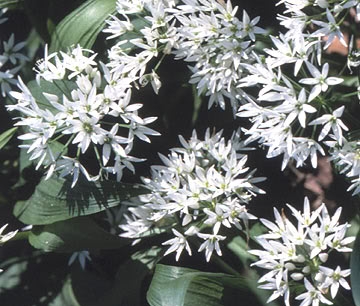
GARLIC (Wild) – Allium Ursinum
Description: Although
Crow Garlic (A. vineale) is fairly common in the countryside while the
Field Garlic (A. oleraceum) is quite rare, it is the very common Ramsons
Garlic (A. ursinum) which is most commonly referred to as ‘Wild’ Garlic.
It has very small bulbs which limit its practical uses.
Flowering from April to June, it has broad leaves similar to
Lily of the Valley and white star-like flowers.
Habitat: Woods and sheltered Valleys.
Common names: poor
man’s treacle, rush leek, snow bell.
Common name of ‘Garlic’ originates from the Anglo Saxon
‘gar’ meaning ‘lance’ and ‘leac’ meaning ‘pot herb’.
Traditional medicinal uses: (Herbs
and plants should never be used for medicinal purposes without first consulting
a qualified herbalist and Doctor).
Hippocrates (300BC) recommended garlic for infections,
wounds, cancer, leprosy, and digestive disorders. Dioscorides praised it for
its use in treating heart problems and Pliny listed the plant in 61 remedies
for a wide variety of ailments ranging from the common cold to leprosy,
epilepsy and tapeworm.
Garlic has been used to lower blood cholesterol levels, thin
the blood, lower blood pressure and enhance blood circulation as well as for digestive
infections, gastric upsets and to lower blood sugar. It has also been used to
prevent infection, heal wounds and for coughs, colds, whooping-cough and chest infections.
It has been used as an antiseptic and continued to be widely used even after
the discovery of penicillin in 1928 when penicillin supplies were unavailable.
During the 2nd World War, Russian doctors relied upon it so much
that garlic was referred to as the “Russian Penicillin”.
Garlic was once used as a cure for leprosy, epilepsy, rheumatism
and smallpox. It was also considered to give protection against the plague.
Additional comments:
The ancient world loved Garlic and it was widely used not only in cooking and
for medicinal reasons but also because it was thought to increase strength and
endurance. Greek athletes would eat huge quantities before competing and Greek
soldiers would do the same before battle. Egyptian slaves would be given daily
rations of Garlic for the same reason and also to ward off illness.
There were exceptions to this love of garlic. Horace hated
it, calling it “more poisonous than hemlock”. The smell of it on a person was
considered a sign of vulgarity even to the extent that people who had eaten it
were not allowed to enter the temples of Cybele.
In the twelfth century, the writer Alexander Neckam
recommends farm labourers to rub Garlic on their lips and noses as a treatment
and preventative for sunburn. Cole's Art of Simpling (1656) advised that
if a garden is infested with moles, placing Garlic in their mole hills will
make them “leap out of the ground”.
Folklore, Myths and Fables:
There is a long tradition that Garlic wards off vampires, evil spirits and
evil spells. When King Tutankhamun’s tomb was excavated, there were bulbs
of garlic found scattered throughout the rooms possibly for this reason.
In ancient times, people used to eat garlic before making a
journey at night as they believed that evil spirits would not come near to
their garlic breath. Midwives would also hang garlic cloves in birthing rooms
to keep evil spirits away and this practice often extended to people’s homes.
Recent research has also shown that the old remedy of using garlic as a
mosquito repellent (diseases caused by mosquito bites were thought to be "the
touch of the vampire"), is in fact reasonably effective.
In some parts of Europe there was the belief that if garlic
was chewed by a person running a race, it would stop their competitors overtaking
them. Hungarian jockeys would also attach a clove of garlic to their horse’s bits
to stop other jockeys overtaking them. It is presumed that no one asked the horses
what they thought of this practice.
Flowering from April to June, it has broad leaves similar to Lily of the Valley and white star-like flowers.
Habitat: Woods and sheltered Valleys.
Common names: poor man’s treacle, rush leek, snow bell.
Common name of ‘Garlic’ originates from the Anglo Saxon ‘gar’ meaning ‘lance’ and ‘leac’ meaning ‘pot herb’.
Traditional medicinal uses: (Herbs and plants should never be used for medicinal purposes without first consulting a qualified herbalist and Doctor).
Hippocrates (300BC) recommended garlic for infections, wounds, cancer, leprosy, and digestive disorders. Dioscorides praised it for its use in treating heart problems and Pliny listed the plant in 61 remedies for a wide variety of ailments ranging from the common cold to leprosy, epilepsy and tapeworm.
Garlic has been used to lower blood cholesterol levels, thin the blood, lower blood pressure and enhance blood circulation as well as for digestive infections, gastric upsets and to lower blood sugar. It has also been used to prevent infection, heal wounds and for coughs, colds, whooping-cough and chest infections. It has been used as an antiseptic and continued to be widely used even after the discovery of penicillin in 1928 when penicillin supplies were unavailable. During the 2nd World War, Russian doctors relied upon it so much that garlic was referred to as the “Russian Penicillin”.
Garlic was once used as a cure for leprosy, epilepsy, rheumatism and smallpox. It was also considered to give protection against the plague.
Additional comments: The ancient world loved Garlic and it was widely used not only in cooking and for medicinal reasons but also because it was thought to increase strength and endurance. Greek athletes would eat huge quantities before competing and Greek soldiers would do the same before battle. Egyptian slaves would be given daily rations of Garlic for the same reason and also to ward off illness.
There were exceptions to this love of garlic. Horace hated it, calling it “more poisonous than hemlock”. The smell of it on a person was considered a sign of vulgarity even to the extent that people who had eaten it were not allowed to enter the temples of Cybele.
In the twelfth century, the writer Alexander Neckam recommends farm labourers to rub Garlic on their lips and noses as a treatment and preventative for sunburn. Cole's Art of Simpling (1656) advised that if a garden is infested with moles, placing Garlic in their mole hills will make them “leap out of the ground”.
Folklore, Myths and Fables: There is a long tradition that Garlic wards off vampires, evil spirits and evil spells. When King Tutankhamun’s tomb was excavated, there were bulbs of garlic found scattered throughout the rooms possibly for this reason.
In ancient times, people used to eat garlic before making a journey at night as they believed that evil spirits would not come near to their garlic breath. Midwives would also hang garlic cloves in birthing rooms to keep evil spirits away and this practice often extended to people’s homes. Recent research has also shown that the old remedy of using garlic as a mosquito repellent (diseases caused by mosquito bites were thought to be "the touch of the vampire"), is in fact reasonably effective.
In some parts of Europe there was the belief that if garlic was chewed by a person running a race, it would stop their competitors overtaking them. Hungarian jockeys would also attach a clove of garlic to their horse’s bits to stop other jockeys overtaking them. It is presumed that no one asked the horses what they thought of this practice.
