THE FIVE ELEMENTS
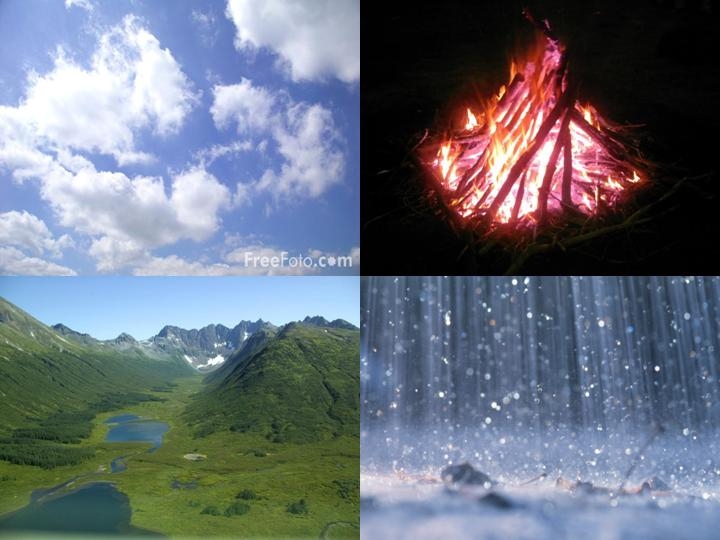
The elements were known to every ancient culture. The Chinese, Tibetans and Vietnamese considered there to be five – Fire, Metal, Water, Wood (ie. Vegetation) and Earth. Confucius wrote:
“The five elements are distributed through the four seasons ….. and in their movements alternately displace and exhaust one another. Each one of them, in the revolving course of the twelve months of the four seasons, comes to be in its turn the fundamental one for the time.”
(ie. The phase of Wood represents Spring, the expansion of Fire is summer moving to Earth for the Harvest, the contraction of Metal is Autumn and the return of energy to the root in the Water phase is Winter.)
“Man is the visible embodiment of the five elements.”
According to Empedocles, a Greek philosopher, scientist and healer who lived in Sicily in the fifth century B.C., all matter is comprised of four "roots" or elements of earth, air, fire and water. In his Tetrasomia, or Doctrine of the Four Elements, Empedocles described these elements not only as physical manifestations or material substances, but also as spiritual essences. He associated these elements with four gods and goddesses - air with Zeus, earth with Hera, fire with Hades, and water with Nestis (believed to be Persephone):
Of course we do not know what the ancient Druids believed as there is no written record of their beliefs nor are their beliefs about the Elements mentioned in the writings about Druids by Roman and Greek historians. But in view of what we do know about Druid contact across the whole of the ancient World, it is likely they shared the Greek belief about the Elements.
Modern Druidry draws heavily on writings from the Druid Revival in the 17th and 18th Century. Disillusioned with Christianity and searching for an indigenous British belief, writers such as John Aubrey, William Stuckely and Owen (later Iolo) Morgan, searched Roman and Greek writings and the later Irish and Welsh stories in an attempt to find the beliefs of the ancient Druids. As we know, such writers were not afraid to fill in the gaps with their own invention and this continues to undermine the validity of modern Druidry in many people’s minds.
But when you consider how ancient is the belief in the Elements, I do think this is one part of modern Druidry which does have substance.
When we consider the elements, we should not do so in their purely material form. As Empedocles recognised, they have a spiritual and metaphysical form as well as material. When Confucius says “Man is the visible embodiment of the five elements”, he is referring to every aspect of what makes a living being. With that in mind, let us now consider the five elements within Druidry.
Earth - Calas (pronounced "CAH-lass") comes from the same root as calad, Welsh for "hard," and means "solidity." As an element, calas is the source of form, differentiation, manifestation, and stability.
Water - Gwyar (pronounced "GOO-yar") literally means "blood" in old Welsh, but its more general meaning is "flow" or "fluidity." As an element, gwyar is the source of change, motion, growth, and decay.
Air – Awyr (pronounced “OH-ir”) is old Welsh for atmosphere and wind.
Fire – Ufel (pronounced “IV-el”) is old Welsh for fire or conflagration.
Nwyfre (pronounced "NOOiv-ruh") is an old Welsh term meaning "sky" or "heaven." As an element, nwyfre is the source of life and consciousness, and modern Druids often refer to it simply as the life force. It may seem a paradox that like the Element Air, Nwyfre also refers to sky but in most languages, air, breath and spirit have common roots - eg. the English word spirit itself comes from the Latin word “spiritus” meaning breath.
| | Nwyfre | Ufel | Awyr | Gwyar | Calas |
| Symbol | Spirit, Life Force | Fire | Air | Water | Earth |
| Colour | White | Red | Yellow | Blue | Green |
| Direction | Centre | South | East | West | North |
| Meaning | Life force, Spirituality | Creativity, Art | Intellect | Emotions | Bounty of the Earth |
Earth – Feminine
Solidity, Basis, foundation, grounded
The physical body, growth, fertility, food
Money, houses, buildings
Strength, sustenance
Positive qualities – reliability, relentlessness, practicality, realism, patience, comradeship, craftsmanship
Negative qualities – boredom, sloth, lack of enterprise, cliquishness, leaving initiative to others.
Sign – Capricorn, Taurus, Virgo
Water – Feminine
Cleansing, purifying,
The emotions, love, feelings, sensitivity, receptiveness, passivity
Subconscious, Dreams, depth,
Blood, sweat, tears
Positive qualities – receptiveness, imagination, intuition, sensing, dreaming and day dreaming, perception, prophecy, sensing
Negative qualities – withdrawl, victimhood, dependence, vagueness, deviousness.
Sign – Cancer, Scorpio, Pisces
Air – Masculine
Intellect, detachment, thought, intelligence, the mind, logic, positive thinking
Inspiration, life, breath,
Positive qualities – scientific, clear-headed, inquisitive, problem solving, rational,
Negative qualities – dry intellect, harshness, absent-mindedness, confusion, uncertainty.
Sign – Libra, Aquarius, Gemini
Fire – Masculine
Positive, energy, aspiration, enthusiasm, dedication
Aspiration, mastery, the Will
Positive qualities – Lively mind, wit, ideas, seeing sharply, initiative, drive, leadership, energy, force of character, strength of purpose, making an impression.
Negative Qualities – Deceit, cunning, impracticality, dictatorial, bad tempered, erratic, chaotic, over imposing.
Sign – Aries, Leo, Sagittarius
Born in the Solar System, we all hold within us every element and every sign. Our moment of birth decides the extent of influence on the new-born of each element and sign.
Nwyfre – (pronounced "NOOiv-ruh") Nwyfre is like the prana of yoga, or the Chi’ (pronounced “Chee”) of the Taoists. It is the constant stream of life energy flowing through every person, creature, tree, and stone. It is the current which travels along the web of life, the unifying energy which connects us all. When combined with Earth, Water, Air and Fire, the result is Life.
When we form and cast the circle, we are creating not just a place for our ritual. We are creating a focus. A central point in the middle of the circle through which we connect via the Nwyfre to the whole web of Life on this lovely Planet. And when we welcome the Elements to our Circle, we do so not just in the physical sense. We are embracing them for all their gifts that make us what we are.
Nwyfre should not be confused with Awen. They are separate but complementary. Awen is an elusive energy within this world that brings illumination, wisdom and inspiration. It is a universal force that we seek to find and join with through the Awen chant to gain its gifts. Nwyfre, the Life force is also an energy but it is always flowing through us all. In ritual, we seek to connect through this Life Force with the whole natural world.