Comfrey: (Symphytum officinale)
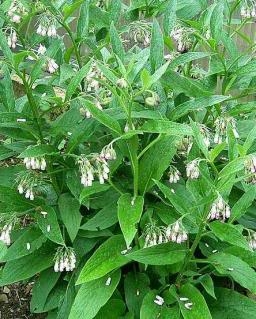
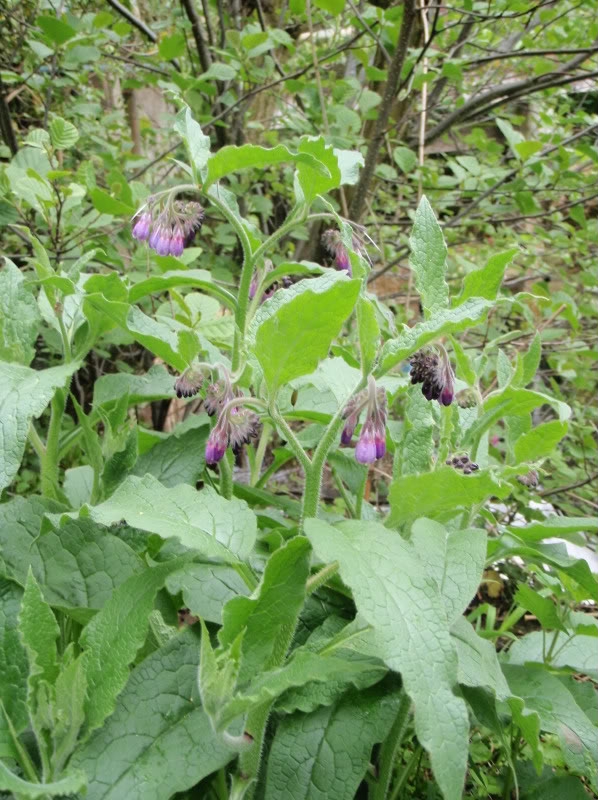
Description:. Member of the Borage and Forget-Me-Not family. Leafy hollow stem 2 to 3 feet high covered with bristly hairs. Very large ovate shaped lower leaves up to 10 inches long covered with rough hairs which promote itching when touched. Upper leaves decrease in size the higher they grow up the stem, Clusters of drooping creamy yellow flowers grow on short stalks at top of stem. The purple flowering Comfrey is one of 25 varieties as is the 5 foot high blue flowering Comfrey which was introduces from the Caucasus in 1811 as a fodder plant. Comfrey blooms throughout most of the Summer with first flowers opening at the end of April or early May.
Habitat: Native of Europe and temperate Asia. Common throughout England in watery places including banks of rivers and ditches.
Common Names: Common Comfrey, Knitbone. Knitback.
Nipback, Consound. Blackwort. Bruisewort. Slippery Root. Boneset. Yalluc
(Saxon). Gum Plant. Consolida. Ass Ear, All Heal, Healing Plant, Wall Wort.
Traditional medicinal uses – (Herbs and plants should never be used for medicinal purposes without first consulting a qualified herbalist and Doctor) The leaves of Comfrey may be confused with the first-year rosettes of Foxglove (Digitalis) with fatal results. Always consult an expert on identification first.
Known as a remedy for healing broken bones since at least Roman times when it was named conferva meaning to join together. The name Comfrey is a corruption of this Latin name and the botanical name Symphytum is derived from the Greek symphyo (to unite).
The impressive wound-healing properties of Comfrey are partially due to the presence of allantoin which stimulates cell proliferation accelerating wound-healing.
The following is from the Chemist and Druggist of August 13, 1921:
'Allantoin is a fresh instance of the good judgment of our rustics, especially of old times, with regard to the virtues of plants. The great Comfrey or consound, though it was official with us down to the middle of the eighteenth century, never had a very prominent place in professional practice; but our herbalists were loud in its praise and the country culler of simples held it almost infallible as a remedy for both external and internal wounds bruises, and ulcers, for phlegm, for spitting of blood, ruptures, haemorrhoids, etc.
Comfrey has also been used in the past as a remedy for diarrhoea, dysentery, ulcers and psoriasis and also asthma, bronchitis and irritable cough. It is now not used internally as it can cause liver damage.
Additional Comments: A plant high in protein (up to 35%), comfrey is used as an animal feed and organic manure. For the gardener, Comfrey makes an excellent green compost.
A strong decoction has been used on the Continent for tanning leather. In Angora a form of glue is made from the common Comfrey which is used for spinning the famous fleeces of that country. The book Old Ways Discovered states, “The mucilaginous root is employed by colormakers; it is also employed to correct the brittleness of flax and the roughness of wool in spinning.”
Folklore, Myths and Fables – Comfrey leaves put in shoes are thought to protect travellers from illness and misfortune while travelling. A sachet of Comfrey placed in luggage is thought to ensure its safety during transit and safe arrival at its destination.
