
Agrimony – (Agrimonia eupatoria)
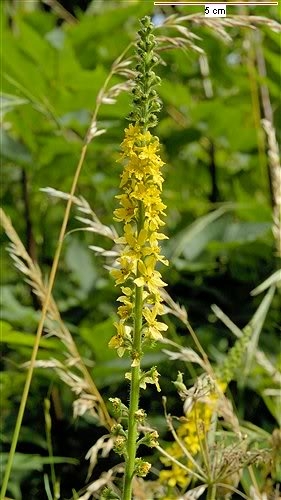
Description - British perennial. Up to 60cm (2 feet) tall. Hairy erect green stem bearing long spikes of bright yellow flowers. Toothed slightly hairy leaves 7 to 8 inches long near ground reducing to 3 inches at top. Fruits enclosed in tough capsule with a circle of hooked spines which cling to any person or animal which comes into contact with the plant (hence “stickwort”).
Flowers June to early September. Whole plant slightly aromatic with flowers scent similar to apricots. Leaves and flowers retain their fragrance when dried.
Habitat – abundant in hedge-banks, side of fields, dry thickets and on wasteland.
Common Names - common agrimony, church steeples, cockeburr, cocklebur, stickwort, sticklewort, Burr marigold, Garclive, Philanthropos.
The name Agrimony is from ‘Argemone’, a word given by the Greeks to plants which were healing to the eyes. Also called ‘Lemonade’ in Somerset where lemons, oranges, ginger and sugar are added to the flowers to make a cold cure.
Traditional medicinal uses – (Herbs and plants should never be used for medicinal purposes without first consulting a qualified herbalist and Doctor)
Pliny referred to it as a 'herb of princely authoritie'. Anglo-Saxons – healing wounds, snake bites and warts. Native Americans – treating fevers.
Culpepper (1652) wrote “The decoction of the herb, made with wine and drunk, is good against the biting and stinging of serpents” and that it 'draweth forth thorns, splinters of wood, or any such thing in the flesh and helpeth to strengthen members that are out of joint.”
15th century - prime ingredient of 'arquebusade water' - battlefield remedy for gunshot wounds.
France today - sprains and bruises.
Once believed to have anti-bacterial and anti-parasitic actions – was used for tapeworm, dysentery and malaria.
Traditional Chinese medicine – stopping bleeding, profuse menstruation and tuberculosis.
Additional comments – Plant yields yellow dye. Used in dressing leather. Eaten by sheep and goats but not by horses, cattle or swine. In some country districts, dried leaves brewed into a ‘spring drink' or 'diet drink'. In France used as a herbal tea.
Folklore, Myths and Fables - One of 57 herbs in Anglo Saxon ‘Holy Salve’ to ward off goblins and evil. Agrimony considered to be a potent cure for ‘elf-shot’. Magic power of Agrimony mentioned in an old English medical manuscript:
'If it be leyd under mann's heed,
He shal sleepyn as he were deed;
He shal never drede ne wakyn
Till fro under his heed it be takyn.'
